
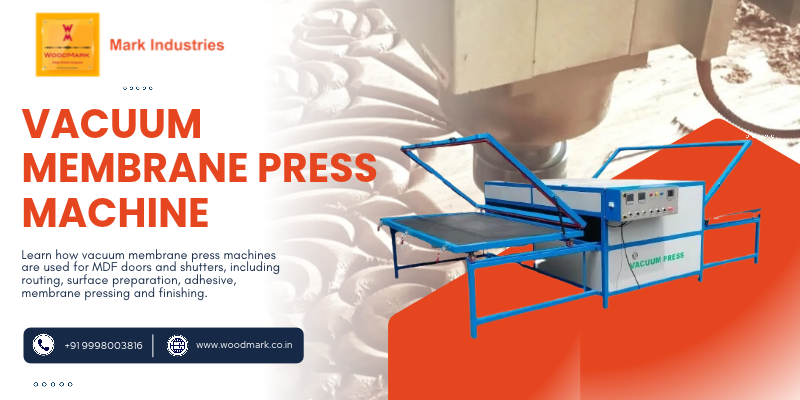
Routed MDF doors and shutters are widely used in modular kitchens, wardrobes, cabinets and other furniture applications.
Unlike simple flat panels, these components can contain grooves, recessed areas, edge profiles and decorative patterns. A vacuum membrane press for MDF doors helps apply suitable decorative membrane over these shaped surfaces.
Understanding the complete production sequence is important when planning an MDF shutter manufacturing setup.
Where Are Membrane-Pressed MDF Doors Used?
Membrane-finished MDF components can be used in applications such as:
- Modular kitchen shutters
- Wardrobe doors
- Cabinet doors
- Storage furniture
- TV unit shutters
- Decorative furniture panels
- Custom interior furniture
The component design, membrane and processing method should be selected according to the intended application.
Step 1: MDF Cutting
Step 2: CNC Routing and Profiling
The MDF component can then be machined to create the required decorative design.
A CNC router may be used for:
- Grooves
- Recessed patterns
- Decorative profiles
- Edge designs
- Repeatable door patterns
This stage is particularly important because the routed geometry will influence how the membrane needs to form around the component.
Step 3: Surface Preparation
After machining, dust and residue should be removed from the MDF.
The component should also be inspected for machining defects or surface irregularities.
Particular attention should be given to routed areas and edges.
Good preparation creates a cleaner base for adhesive application and membrane pressing.
Step 4: Adhesive Application
A suitable adhesive system is applied according to the requirements of the membrane, substrate and production process.
Uniform application is important, particularly around profiles and edges.
Adhesive type, application quantity and processing conditions should follow the relevant supplier’s recommendations.
Step 5: Membrane Pressing
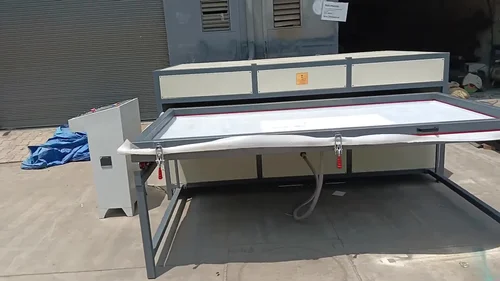
Prepared MDF components are arranged within the usable area of the vacuum membrane press.
The membrane is positioned and processed using controlled heating and vacuum.
As the membrane reaches suitable forming conditions, vacuum helps it conform around the surface and routed profile of the MDF component.
Machine settings should be established according to the materials and component being processed.
Step 6: Trimming and Inspection
After pressing and appropriate handling or cooling, excess membrane can be trimmed according to the production process.
The finished shutter should then be inspected.
Important areas include:
- Corners
- Edges
- Routed grooves
- Recessed areas
- Surface appearance
- Bonding consistency
Quality checks can help identify process variations before components move to subsequent furniture-production stages.
What Makes MDF Door Pressing Challenging?
The complexity of an MDF door matters.
A relatively simple profile may be easier to process than a design containing deep grooves, sharp transitions or complicated decorative details.
Manufacturers should therefore consider both aesthetics and manufacturability when developing door designs.
Testing new profiles before large-scale production can help establish appropriate processing parameters.
Machinery Used in MDF Shutter Production
A membrane press is only one part of the production workflow.
Depending on the factory and product, MDF shutter manufacturing may involve equipment for:
Panel cutting → CNC routing → Surface preparation → Adhesive application → Vacuum membrane pressing → Trimming & inspection
A well-planned workflow helps prevent one process from becoming a bottleneck for another.
What Should Manufacturers Consider Before Selecting a Machine?
| Requirement | What to Evaluate |
|---|---|
| Door dimensions | Maximum length and width |
| Working area | Number of components per load |
| Door design | Groove and profile complexity |
| Membrane | Material and processing requirements |
| Production volume | Required output per shift |
| Heating | Suitable and controlled processing |
| Vacuum system | Performance for intended profiles |
| Factory space | Installation and operating area |
Actual machine selection should be based on the manufacturer’s production requirements rather than one specification alone.
FAQs
Can a vacuum membrane press be used for routed MDF doors?
Is CNC routing required before membrane pressing?
Can kitchen and wardrobe shutters use the same membrane press?
Conclusion
Using a vacuum membrane press for MDF doors allows furniture manufacturers to process suitable decorative membranes over routed and shaped MDF components.
However, finished quality begins well before the pressing stage. Accurate cutting, routing, surface preparation, adhesive application, membrane processing and inspection all contribute to the overall manufacturing process.
For manufacturers setting up or expanding MDF door production, the membrane press should therefore be selected as part of the complete furniture manufacturing workflow rather than as an isolated machine.