
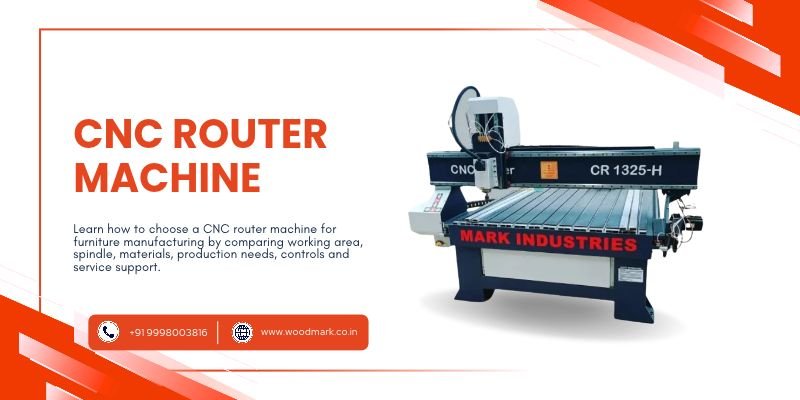
A CNC router can handle a wide range of machining operations in furniture production, from cutting panels to creating grooves and decorative patterns.
However, machine requirements can vary considerably between a small custom furniture workshop and a production facility manufacturing cabinets or modular furniture.
Knowing how to choose a CNC router machine starts with understanding what you actually need to manufacture.
1. Define Your CNC Router Applications

Before comparing specifications, identify the operations you expect the machine to perform.
Furniture manufacturers may use CNC routers for:
- MDF cutting
- Plywood machining
- Furniture component routing
- Cabinet components
- Grooving
- Drilling
- Decorative patterns
- Door and shutter designs
A machine intended primarily for decorative MDF routing may have different requirements from one used extensively for panel processing.
2. Select the Right Working Area
Working area should match the dimensions of the material and components you normally process.
Consider both the maximum sheet size and finished component dimensions.
An unnecessarily large working area may increase machine footprint, while an undersized machine can restrict future production.
Before requesting a quotation, prepare your common sheet and component dimensions.
3. Consider the Material You Machine
Different materials create different machining requirements.
A woodworking CNC router may process materials such as MDF, plywood and other suitable board products depending on its configuration and tooling.
Tell the machinery manufacturer:
- Material type
- Material thickness
- Typical sheet dimensions
- Required machining operations
- Expected production volume
This information is more useful than asking for a CNC router based solely on price.
4. Evaluate the Spindle Requirement
The spindle is a major component of a CNC router.
Rather than automatically choosing the highest available spindle rating, consider the material, tooling and operations your production requires.
Discuss spindle configuration with the machinery manufacturer based on the actual work you intend to perform.
Higher specifications are useful only when they solve a genuine production requirement.
5. Consider Production Volume
A workshop producing occasional custom components has different requirements from a factory running repetitive production throughout the day.
Estimate:
Components per day + operating hours + product variety + machining complexity
These factors help determine the level of machine configuration and production capability your operation needs.
6. Check Software and Controls
The CNC router must convert your designs into accurate machining movements.
Before buying, understand the complete workflow from design to finished component.
Ask about:
- Machine controller
- Compatible file workflow
- Operator interface
- Training requirements
- Toolpath preparation
- Support for the intended machining operations
Your operators should understand both the machine and the production workflow around it.
7. Consider Dust Management
Routing MDF and other woodworking boards can generate significant dust.
Dust extraction should therefore be considered when planning a CNC router installation.
A suitable dust-management arrangement helps keep the production area cleaner and supports routine machine maintenance.
Dust collection requirements depend on the material, machine configuration and production environment.
8. Evaluate Service and Training
A CNC router is not simply a machine that arrives, gets plugged in, and magically starts carving cabinet doors.
Installation, operator training and technical support matter.
Before ordering, ask about:
- Installation assistance
- Operator training
- Warranty
- Spare parts
- Technical support
- Preventive maintenance requirements
Reliable support can become especially important when CNC equipment is central to daily production.
CNC Router Buying Checklist
| Factor | Requirement to Define |
|---|---|
| Material | MDF, plywood, etc. |
| Sheet size | Maximum dimensions |
| Working area | Required machining area |
| Operations | Cutting, routing, grooving, drilling |
| Component design | Simple or complex |
| Production | Pieces/sheets per shift |
| Spindle | Based on machining requirement |
| Software | Production workflow compatibility |
| Dust extraction | Factory requirement |
| Support | Installation, training and service |
Avoid Choosing a CNC Router Only by Price
Two CNC routers can appear similar in a quotation while differing in configuration, construction, controls, components and support.
Instead of asking only:
“What is the CNC router price?”
provide the manufacturer with your material, sheet size, component drawings, operations and production requirements.
This allows equipment to be evaluated against the work it actually needs to perform.
FAQs
Which CNC router is suitable for furniture manufacturing?
Can a CNC router machine MDF?
What working size should I choose?
Should I choose the CNC router with the highest spindle power?
Conclusion
Learning how to choose a CNC router machine begins with your production requirements.
Define the material, sheet size, machining operations, component designs and expected production volume before comparing machine configurations.
For furniture manufacturers, the right CNC router should fit into the complete production workflow and provide the machining capability required for current and planned products.
Woodmark provides woodworking machinery solutions for furniture manufacturing requirements, allowing buyers to evaluate CNC equipment according to their actual production applications.