Vacuum membrane pressing is widely used in furniture manufacturing to cover shaped and routed components with decorative membrane material.
It is commonly associated with products such as kitchen cabinet shutters, wardrobe doors and decorative MDF panels.
But how does the process actually work?
Understanding the vacuum membrane press working principle can help furniture manufacturers plan production, train operators and identify the factors that affect finished component quality.
What Is the Basic Working Principle?
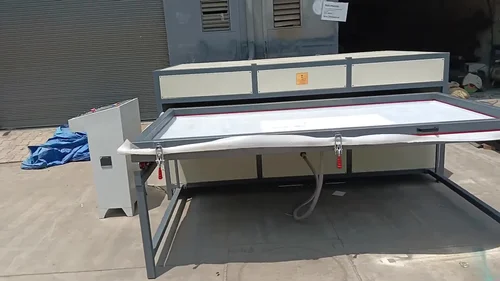
“How many pieces can this machine produce per day?” is an important question when investing in furniture machinery.
But vacuum membrane press production capacity cannot always be represented accurately by one fixed number.
Actual output depends on the working area, component dimensions, loading arrangement, processing cycle and factory workflow.
Understanding these factors helps manufacturers estimate capacity more realistically.
1. Usable Working Area
2. Component Size
Depending on the membrane system and application, a suitable adhesive is applied to the required areas of the component.
The adhesive must be compatible with the substrate and membrane being used.
Application method, quantity and drying or activation conditions should follow the recommendations provided by the relevant adhesive supplier.
Uneven adhesive application can contribute to inconsistent bonding.
3. Loading Arrangement
4. Processing Cycle Time
The complete production cycle should be considered when calculating output.
A simplified cycle may include:
Loading → Process preparation → Heating → Vacuum forming → Completion → Unloading
The exact sequence and duration depend on the machine, membrane, adhesive and component.
Therefore, buyers should avoid assuming that one advertised process time represents total real-world production time.
5. Product Complexity
A simple component and a deeply routed decorative shutter may have different process requirements. Factors such as: Profile depth Routed design Membrane characteristics Component thickness Adhesive system can influence production conditions. Factories producing many different designs should consider this product variation when estimating daily capacity.
What Factors Affect Membrane Pressing Quality?
A simple component and a deeply routed decorative shutter may have different process requirements.
Factors such as:
- Profile depth
- Routed design
- Membrane characteristics
- Component thickness
- Adhesive system
can influence production conditions.
Factories producing many different designs should consider this product variation when estimating daily capacity.
6. Operator and Workflow Efficiency
The machine is only one part of the production line.
Output can also be affected by how quickly components are prepared, loaded, unloaded, inspected and moved to the next production stage.
For example, delays in MDF preparation or adhesive application can leave the membrane press waiting even when the machine itself has available capacity.
This means production planning should consider the complete workflow rather than the press in isolation.
How to Estimate Practical Production Capacity
A simple starting calculation is:
Pieces per cycle × completed cycles per shift = estimated pieces per shift
For example, if a particular component layout allows several pieces to be processed together, manufacturers can combine that quantity with their validated complete cycle time to estimate shift output.
This should be treated as a planning estimate, not a guaranteed production figure.
Material changes, product complexity, operator workflow, maintenance and other factory conditions can affect actual results.
Production Capacity Checklist
| Factor | Why It Matters |
|---|---|
| Working area | Determines available loading space |
| Component dimensions | Determines pieces per load |
| Loading arrangement | Affects space utilization |
| Complete cycle time | Determines possible cycles per shift |
| Product design | May affect process requirements |
| Material | Can influence processing conditions |
| Operator workflow | Affects loading and unloading efficiency |
| Upstream production | Determines component availability |
Should You Buy a Larger Machine for Future Growth?
Not automatically.
A larger machine may provide additional working area, but the investment should be based on expected products and realistic production growth.
Before selecting capacity, consider:
- Current daily production
- Expected future demand
- Common component dimensions
- Product mix
- Number of working shifts
- Available factory space
- Upstream and downstream capacity
The most suitable machine is one that fits into the overall manufacturing process rather than creating excess capacity that other production stages cannot support.
FAQs
How many pieces can a vacuum membrane press produce per day?
Does a bigger working area mean higher production?
How should I compare the capacity of two membrane press machines?
Conclusion
Vacuum membrane press production capacity should be calculated using real production requirements rather than a single advertised output figure.
Working area, component dimensions, loading pattern, complete cycle time, product complexity and factory workflow all influence practical capacity.
Before selecting a machine, furniture manufacturers should prepare their common component sizes and expected daily output. This makes it easier to discuss an appropriate membrane pressing configuration with a woodworking machinery manufacturer.