
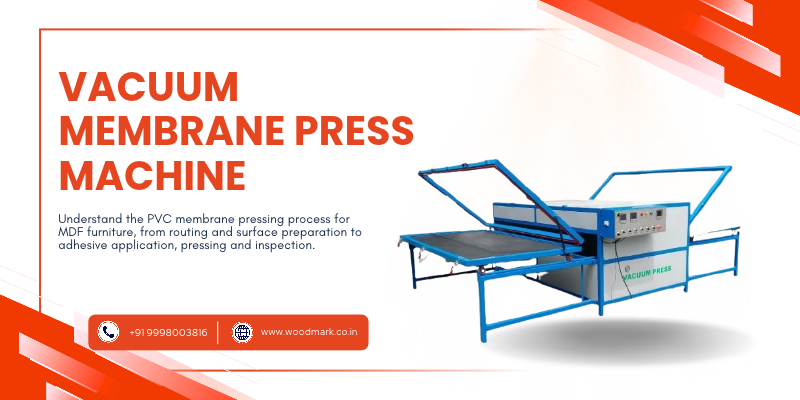
PVC membrane finishes are used on various MDF furniture components, particularly where decorative routed designs and profiled surfaces are required.
The PVC membrane pressing process involves more than simply placing a membrane over MDF. Component machining, surface preparation, adhesive application and controlled pressing all contribute to the finished result.
Here is a practical overview of the production process.
1. MDF Component Preparation
Production begins with MDF cut to the required dimensions.
Depending on the furniture design, the component may then be routed to create:
- Decorative grooves
- Recessed patterns
- Edge profiles
- Door designs
- Surface detailing
Accurate machining helps maintain consistency when the same design is produced repeatedly.
2. Surface Cleaning and Preparation
3. Adhesive Application
4. Component Loading
Prepared components are positioned within the working area of the vacuum membrane press.
Component arrangement should consider:
- Available working area
- Component dimensions
- Spacing
- Profile design
- Production quantity
A repeatable loading arrangement can make routine production easier to manage.
5. PVC Membrane Positioning
6. Heating and Vacuum Pressing
During processing, controlled heat prepares the membrane for forming.
Vacuum then helps the membrane conform around the MDF component, including suitable edges, grooves and decorative profiles.
The required conditions depend on factors such as:
- PVC membrane
- Adhesive
- MDF component
- Profile depth
- Machine configuration
For this reason, one universal temperature or processing time should not be assumed for every material combination.
7. Trimming and Finishing
8. Quality Inspection
Inspecting finished components helps identify process inconsistencies.
Check areas such as:
Surface: Look for visible irregularities.
Edges: Check membrane bonding around the perimeter.
Grooves: Inspect whether the membrane has formed correctly inside routed areas.
Corners: Look for lifting, wrinkles or other visible defects.
Consistency: Compare components from the same production batch.
If defects repeatedly occur in the same area, the relevant component design, material and processing conditions should be investigated.
Where Is PVC Membrane Pressing Used?
Common furniture applications can include:
| Application | Typical Component |
|---|---|
| Modular Kitchen | MDF shutters |
| Wardrobe | Decorative doors |
| Cabinets | Door fronts |
| TV Furniture | Decorative shutters |
| Storage Furniture | Cabinet panels |
| Interior Furniture | Routed MDF components |
What Affects PVC Membrane Pressing Quality?
Several factors work together:
- MDF surface quality
- Routing quality
- Component geometry
- Adhesive selection and application
- PVC membrane characteristics
- Heating conditions
- Vacuum performance
- Loading arrangement
- Operator consistency
This is why troubleshooting should consider the complete process rather than changing one machine setting immediately.
FAQs
What is PVC membrane pressing?
Why is MDF routed before membrane pressing?
What temperature is required for PVC membrane pressing?
What furniture products use PVC membrane pressing?
Conclusion
The PVC membrane pressing process for MDF involves a sequence of machining, surface preparation, adhesive application, component loading, membrane positioning, controlled pressing, trimming and inspection.
Consistency at every stage matters. A well-prepared MDF component cannot compensate for an unsuitable pressing process, and good machine performance cannot compensate for poor surface preparation.
Furniture manufacturers should therefore treat membrane pressing as a complete production process, with the machine, MDF, adhesive and PVC membrane working together.